
I've put together these two Candida Diet Food List PDF summaries to help to give you a snap-shot of the types of foods you should be eating and avoiding while following a candida diet.
Feel free to right click and save the summaries for your own personal reference.
Jump to:
Introduction
Candida is a type of yeast that is naturally present in the human body. In healthy individuals, the yeast is kept in balance by the body’s immune system and other microorganisms in the gut. However, when the body’s natural balance is disrupted, the yeast can grow out of control, leading to a condition known as candidiasis and a variety of unpleasant symptoms.
The good news is that candidiasis is treatable. One of the most effective treatments is the candida diet, which involves eliminating foods that fuel Candida and worsen symptoms, while simultaneously consuming foods that increase your immune system, fight Candida, and promote healing.
Read on to find out which foods you should be eating, and which you should be avoiding while on a Candida Diet.
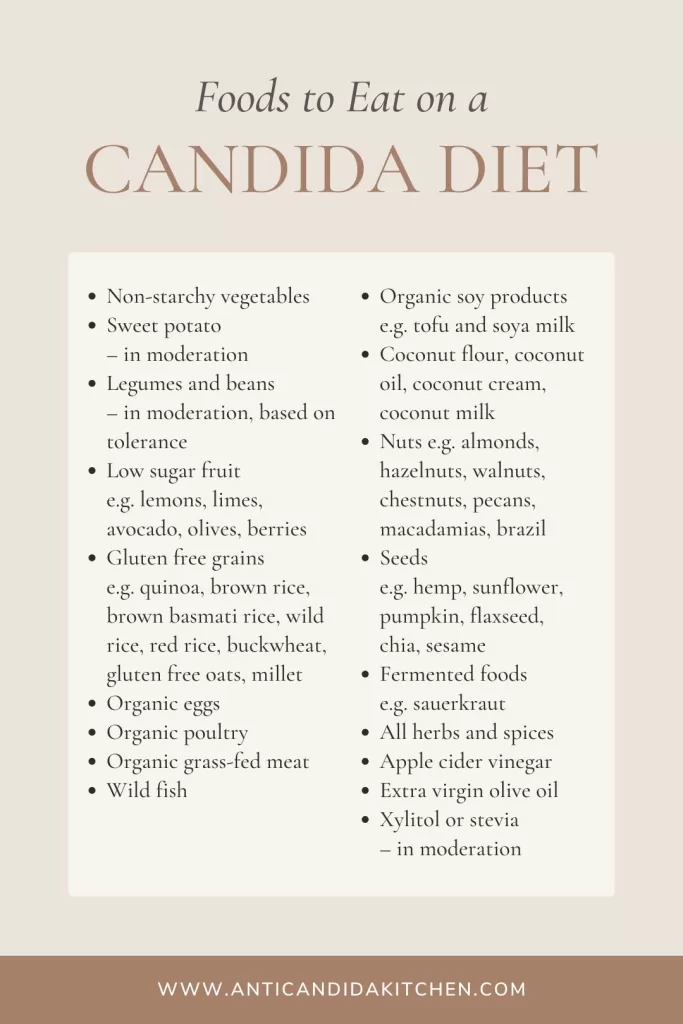
✅ Foods to Eat on the Candida Diet
- Non-starchy vegetables
- Sweet potato – in moderation
- Legumes and beans – in moderation, based on tolerance
- Low sugar fruit e.g. lemons, limes, avocado, olives, berries
- Gluten free grains e.g. quinoa, brown rice, brown basmati rice, wild rice, red rice, buckwheat, gluten free oats, millet
- Organic eggs
- Organic poultry
- Organic grass-fed lean meat
- Wild fish
- Organic soy products e.g. tofu and soya milk
- Coconut flour, coconut oil, coconut cream, coconut milk
- Nuts e.g. almonds, hazelnuts, walnuts, chestnuts, pecans, macadamias, brazil nuts
- Seeds e.g. hemp, sunflower, pumpkin, flaxseed / linseed, chia, sesame
- Fermented foods e.g. sauerkraut
- All herbs and spices
- Apple cider vinegar
- Extra virgin olive oil
- Xylitol or stevia – in moderation
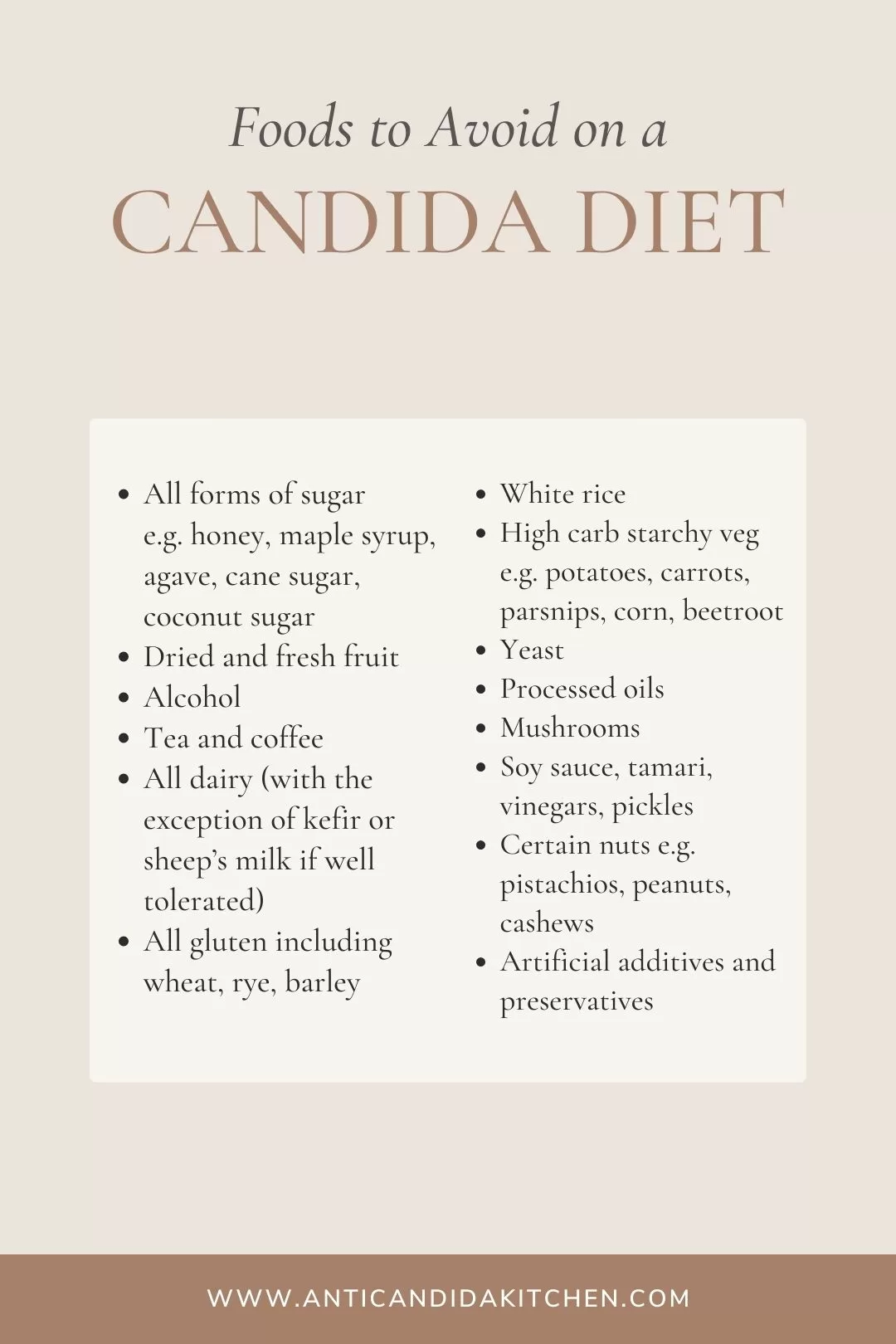
❌ Foods to Avoid on the Candida Diet
- All forms of natural and refined sugar e.g. honey, maple syrup, agave, cane sugar, coconut sugar
- Dried and fresh fruit
- Alcohol
- Tea and coffee
- All dairy (with the exception of kefir or sheep’s milk if well tolerated)
- All gluten including wheat, rye, barley
- White rice
- High carb starchy veg e.g. potatoes, carrots, parsnips, corn, beetroot
- Yeast
- Processed oils
- Mushrooms
- Soy sauce, tamari, vinegars, pickles
- Certain nuts e.g. pistachios, peanuts, cashews
- Artificial additives and preservatives
Conclusion
The goal of a Candida Diet is to eliminate foods that fuel Candida and worsen symptoms, while simultaneously consuming foods that increase your immune system, fight Candida and promote healing.
Over time and once you are healed, you will be able to gradually reintroduce a wider variety of foods back into your diet.
I hope you enjoyed these two Candida Diet Food List PDF summaries and found them useful.
Please note, the above lists are a general representation of the diet only. You should tailor the list dependent on your own allergies and intolerances. Seek advice from a healthcare professional if you are in any doubt.
Looking for some Candida Diet friendly recipes? Check out the Candida Diet Recipes section of the blog, or check out my top Candida Diet Recipes you won't believe are actually healthy!



Nevada Prez says
I like your blog.
Carly says
Hi Nevada! Thank you for your kind comment, I am glad you enjoy the blog 💚
Anthony Lux says
Thank you for sharing this with me and the world. One question . . . based upon your experience, how many months of a strict diet combined with anti-fungal herbs like oil of oregano, garlic, clove etc does it take to fix a fungal overgrowth?
Carly says
Hi Anthony - that's a difficult question to answer as it will greatly depend on the severity of the overgrowth, the health of the individual, how strictly they follow any treatment plan etc. I can answer for me personally, I followed the diet (I also took antifungals) for one year before I was retested and confirmed that my body was healthy again (that's not to say that it was not healed sooner, but that is just how long we waited to retest). And I certainly felt the physical benefits kick in between months 2-6. I hope that helps!
Anthony Lux says
Carly - Thank you for your reply. That means a lot. I was diagnosed with Ulcerative Colitis in 2008 with 20 bloody bowl movements per day when under flare. With a recent diagnosis from a dermatologist 18 years later and after having quit my job ten years ago, I wish my gastroenterologist and my family doctor were HONEST & COMPETENT, but they are liars. I didn't have UC. I took two rounds of antibiotics in 2006 & 2007 and lost 20 lbs within two months. I was clueless how my body worked at the time. Now, I know a lot. My sinuses have actually been congested with candida since at least my 20's and now I am 60. I showed my nails to the dermatologist about 7 weeks ago and she immediately told me that I had a candida albicans overgrowth. No testing. One more question. How does one get tested for candida albicans? I was previously informed in a Youtube video that testing is challenging to impossible to verify. I know that I will be healed or healing when my weight starts coming back. I was a 207 lb bodybuilder of sorts and I have been lingering in the 150's and 160's for most of the past ten years. My high school weight was 173. I wish you love, peace and joy and thank you again for sharing your knowledge and wisdom with me and the world.
Carly says
Hi Anthony - thank you for sharing your story, this sounds like such a challenging journey. Although it sounds like you have suffered much worse symptoms than I have, I can relate to that feeling of frustration of just not knowing what is happening to your body and therefore not knowing how to fix it, that must have been so awful for you. Candida overgrowth does not seem to be common knowledge among practitioners so you certainly need to be lucky enough to find someone with that specialist knowledge. Gut health in general seems to be becoming a lot more mainstream so I do hope that with that comes more education and solutions for people out there suffering, as I believe it is a common issue a lot of people are dealing with without realising! In terms of testing, you can either have a stool or urine test. I did a urine test (organic acid test) which essentially checks for the waste products created by the bacteria/fungi in your gut which helps to indicate what is there. Wishing you the best of luck and I hope you find the answers you need!